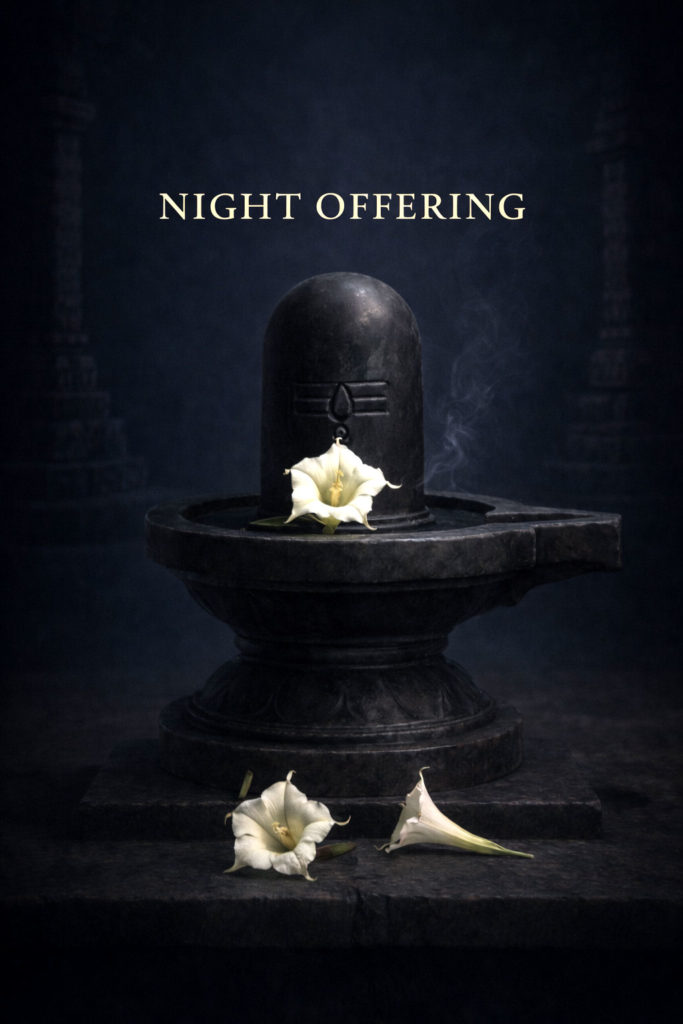
Night Offering is shaped around the datura bloom: white, luminous, and opening into the dark. This is not a conventional dark floral, but a ritual perfume of offering — devotional, nocturnal, and held in restraint.
In Shaivite tradition, datura is one of the flowers offered to Shiva. Placed upon the Shivling, it carries an atmosphere of surrender, transformation, and sacred danger. Night Offering draws on that current, approaching the flower not as ornament, but as presence: grave, beautiful, and watchful.
The scent opens in pale floral radiance, touched by a faint green tension, then deepens into resinous warmth and shadow. It wears close to the skin, unfolding slowly, with a character that is magnetic without excess and sensual without softness.
Ritual use
Suited to shrine work, night meditation, vigils, lunar rites, and other forms of contemplative practice.
Best suited for
shrine offerings and devotional work
evening meditation and silent practice
lunar and threshold rites
those drawn to floral darkness with discipline rather than excess
Practical note
For external use only.
Night Offering belongs to the hour when the night bloom opens, and the world grows quieter. It is a perfume of offering, threshold, and beauty held close to danger — not as spectacle, but as atmosphere.
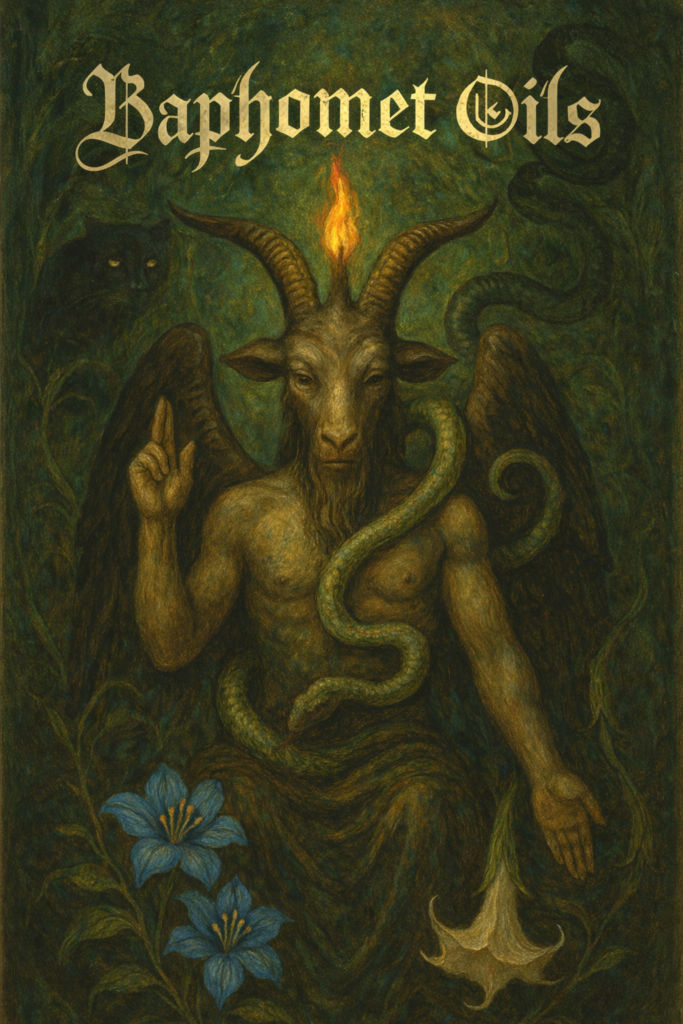
Baphomet is not a symbol of rebellion, nor a mask for shock or inversion. Baphomet is a glyph of wholeness — a living image for the union of opposites, the generative tension between matter and spirit, instinct and intellect, sex and death, form and dissolution.
Baphomet appears where systems collapse into paradox: male and female, human and animal, angel and beast, fertility and annihilation. Not as a contradiction, but as a continuum. A living axis through which power moves.
The Baphomet Current
In the Morgan Witches’ current, Baphomet is understood as:
a cosmic mediator, not a demon
an embodied intelligence, not an abstraction
a process, not an idol
Baphomet arises wherever life recognises itself as both generative and destructive — wherever becoming is more important than purity.
This is the Baphomet of alchemical marriage, deep ecology, the magician’s double, the horned god after theology.
Not Satan. Not parody. Not a reaction.
The Scent — Dual Formula
The Baphomet perfume oil has been reworked as a dual formula, expressing two complementary aspects of the same current.
Both oils share a foundation of green resins, dark balsams, animalic warmth, and narcotic florals. From this shared body, the formula diverges into two distinct expressions:
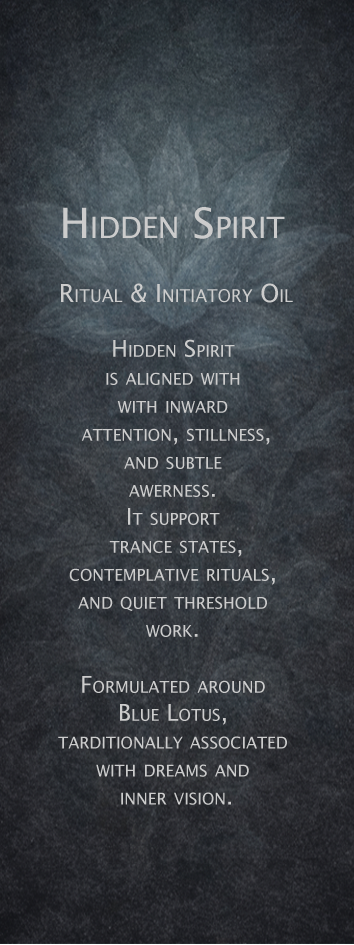
Hidden Spirit — centred on Blue Lotus
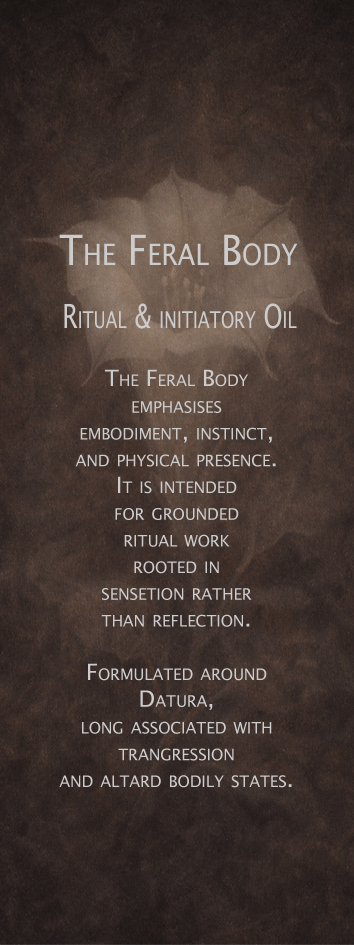
The Feral Body — centred on Datura
These are not variations for preference, but two different modes of engagement with the Baphomet current: one interior and visionary, the other somatic and transgressive.
Key materials:Tuberose · Datura · Galbanum · Elemi · Ambergris
Character
The Feral Body opens with the lush intensity of tuberose, immediately edged by the narcotic unease of datura. Sharp green galbanum cuts through the floral weight, while elemi and ambergris thicken the composition into resinous warmth and animalic gravity.
Orientation
Embodied, chthonic, transgressive
Magical use
This oil is formulated for work through the body. It activates instinct, appetite, and physical presence, making it suitable for rites that involve confrontation, threshold stress, or deliberate disruption of comfort.
Best suited for
Embodied ritual and somatic magic
Shadow integration and transgressive workings
Disciplined erotic-magical practice
Engaging Baphomet as horned, feral, and destabilising
Experience
Heat, tension, heightened bodily awareness, and alertness. The scent asserts itself and does not recede.
Practical note
Use sparingly and with clear intent. This is not a neutral or decorative perfume.
*All oils in the Aromagick series are non-refundable and cannot be returned.
Key materials:Blue Lotus · White Lotus · White Oud · Opoponax · Ambergris
Character
Hidden Spirit unfolds through the cool, narcotic clarity of blue lotus, gently supported by white lotus. White oud introduces a pale, incense-like dryness, while opoponax and ambergris lend depth and warmth without pulling the composition fully into the body.
Orientation
Interior, liminal, visionary
Magical use
This oil is formulated for work through perception. It encourages subtle shifts in awareness, making it suitable for trance, divination, and imaginal practice rather than overt somatic activation.
Best suited for
Meditation, trance, and dreamwork
Divination and visionary pathworking
Liminal and initiatory rites
Engaging Baphomet as mediator and inner guide
Experience
Softened mental edges, expanded inner space, and a gentle withdrawal from bodily urgency.
Practical note Most effective through repeated use over time rather than a single, dramatic application.
Together, The Feral Body and The Hidden Spirit articulate two complementary movements of the Baphomet current: descent into the flesh, and withdrawal into vision.
Which Oil Is Right for Your Work?
Choose The Feral Body if your work requires embodiment, confrontation, or disruption. This oil is suited to moments when the body must be fully engaged—when instinct, appetite, and physical presence are part of the operation. It supports rites that test thresholds, surface shadow material, or deliberately unsettle equilibrium.
Choose The Hidden Spirit if your work turns inward, liminal, or visionary. This oil is better suited to trance, divination, and imaginal practice, where perception must loosen without forcing the body into heightened states. It supports sustained, contemplative engagement rather than dramatic intensity.
Some practitioners will find that their work moves between these two modes over time. In such cases, the oils may be used separately according to circumstance, or cyclically, as alternating expressions of the same current.
Neither oil is stronger than the other. Each is precise in what it is designed to do.
Practical note: These oils are intended for intentional ritual and contemplative use; approach with moderation, attentiveness, and respect for your own limits.
Availability
Baphomet perfume oils are produced in small batches and are intended for those already comfortable working with paradox, embodiment, and non-dual magical frameworks.
This is not an introductory product.
It is a tool.
Bottle size: 10 ml.
Important Notice – Shipping of Oils to the United States
Due to recent changes in tariffs and import regulations, we are temporarily unable to ship our oils to customers in the United States. This restriction applies only to our oil products; all other items remain available for international shipping as usual. We appreciate your patience and understanding while we review the new requirements and work to restore full service as soon as possible.
*All oils in the Aromagick series are non-refundable and cannot be returned.
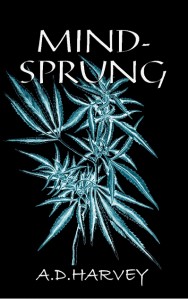
An A-Level drop-out graduates from evicting immigrants during the heyday of the inner-city slum landlords during the 1960s to stripping redundant churches during the early 1970s, before moving to northern Sweden equipped only with the proceeds of selling stolen property and some hashish. He finds new sources of hashish even in Sweden but eventually the money runs out, and he returns to London: only to discover it is even worse than when he left.
Eric Naiman, a Professor of Russian and Comparative Literature at Berkeley, in a six-page attack on A.D.Harvey’s multitudinous literary crimes in THE TIMES LITERARY SUPPLEMENT in 2013, described Harvey’s account of drug-taking and other shenanigans in London and the Swedish Arctic as “unreadable”, but perhaps that was because he hadn’t actually read it. Another of A.D.Harvey’s novels, WARRIORS OF THE RAINBOW was described by THE GUARDIAN as “weirdly compelling” and by THE INDEPENDENT as “free-flowing and poetic….unforgettable.”
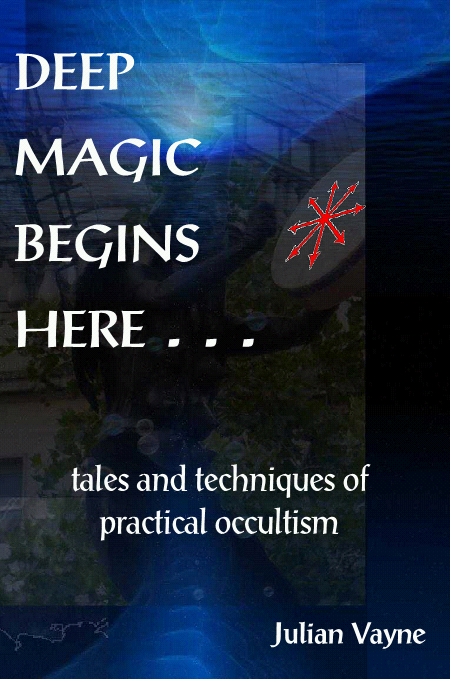
One could read this as a collection of tales recounting magical experiments in practical occultism. But it is also a record of a magical crisis of confidence, a literal dark night of the soul. There are various milestones on this journey, from the mysteries of Witchcraft to tales of the Elder Gods. Deep Magic is a journal written during that long dark night of the soul.
As one might expect from such an articulate commentator, it also brings together practical how-to information, academic writing, and far reaching metaphysical exploration. This book touches on many different magical systems. Informed by the experiential approach of Chaos Magick and diving deep into the Mystery as presented through many traditions, this work explores:
Psychogeography and Magick
Transgressive bodywork
Our Vision of the End Times
Gender fluidity as spiritual process
The Boscastle Museum of Witchcraft
Zombies and the New Age movement
Buddhism meets Chaos Magick
Entheogenic magick, the law and social transformation
Mindfulness practice as the still point in the storm of chaos
The esoteric metaphysics of Pooh Bear, Tigger and Eeyore
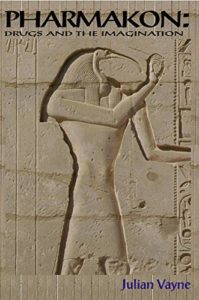
Ranging across both published and anecdotal evidence, Pharmakon traces the story of drug use as a means of self-exploration. By examining apparently simple questions such as ‘what is a drug?’, Pharmakon deconstructs and reconstructs the idea of drug experience. Experiences that the author believes are fundamental to the process of self-actualisation and learning.
Naturally though this book discusses all sorts of things that are currently illegal in many nations the author would never wish to encourage anyone to break the Law. Moreover since this book contains information about how human beings can fly like birds, become transformed into animals and explore the farthest reaches of inner space it is, quite clearly, a work of fiction.
Julian Vayne is an occultist who has written on a number of esoteric subjects (witchcraft, the tarot and the sociology of contemporary Paganism). This book is aimed at both the general reader and those who are interested in the use of drugs in a spiritual context.
Delving into areas as diverse as philosophy and neurochemistry, this is a book that in both style and content seeks to invent a new understanding of drugs in culture….
Review
Pharmakon: Drugs and the imagination, by Julian Vayne
The philosopher’s stoned
By Gary Lachman
Published: 24 December 2006
‘Talking about your drug experiences is like talking about your dreams: it may be personally rewarding, but for others it’s a bore. As with dreams, the insights, visions and revelations that accompany some drug experiences can provide new perspectives on your life and help you to “know yourself”. The person on the receiving end of your dope stories, however, more times than not stifles an impatient “So what?” and wonders when you’ll get to the point. This is the paradoxical character of drug experiences: their profound subjectivity is a barrier to communication.
A handful of writers, De Quincey, Huxley, Burroughs and a few others, managed to cross this threshold and master the art of “trip-lit”. But most accounts of psychedelic journeys into inner space boil down to a less than informative “Awesome, man”. This may let us know that the voyage meant a lot to you, but it still leaves us in the dark as to what was so meaningful about it.
Julian Vayne argues that drugs can be an effective tool in self-exploration, and provides some useful theoretical scaffolding in understanding exactly what a “drug experience” is. Vayne argues that the mainstream materialist view of drugs is incomplete, and he makes clear that the chemical analysis of various substances like LSD, Ecstasy, cannabis and other popular items is only half the story. The importance of “set and setting” and our cultural expectations about exactly what a particular drug is supposed to do are equally crucial; our imagination and anticipation about what we will encounter after ingesting a magic mushroom are at least as significant as the psilocybin housed in the fungus itself. Drug experiences, Vayne contends, are learnt. They aren’t simply a matter of an automatic chemical reaction between my bloodstream and the toxin I’ve introduced to it.
He makes a similar point about how the same drug may have very different effects on different people. A lump of hash may lift a Baudelaire into poetic reverie, but the same lump may only sink the rest of us into befuddled sleep. LSD advocates in the 1960s made a similar discovery when it became painfully clear that taking acid didn’t automatically make people more spiritual and enlightened. The trip, good or bad, is as much in ourselves as in the drug.
Although Vayne has written several books on occult subjects, the occult or magical sensibility informing the book is curiously faint. The tone is academic, and a great part of the book is devoted to the mechanics of how drugs interact with our neurochemistry. He’s also at pains to anchor drug experiences in the post-modern discourse of transgression. This makes for a text in which Derrida turns up almost as often as Aleister Crowley. It’s refreshing to find occultism rubbing shoulders with other viewpoints, but the narrative is sometimes burdened with digressions on the Derridian “trace” and other notions.
Vayne’s most interesting insights come with his discussion of autism and schizophrenia as two poles of human consciousness: one an impenetrable contraction of the ego, the other a debilitating exposure to the chaos of the unconscious. Vayne makes a good argument that, rather than exceptional conditions, autism and schizophrenia are the extremes between which our ‘normal’ consciousness fluctuates; drugs for him are a means of compensating for imbalances between the two. Like many writers on mystical subjects, Vayne sees western culture as veering too much into an ego-bound autism. Hence the virtue of hallucinogens in providing a kind of controlled schizophrenia to even things out.
There are also some howlers. Theophile Gautier and the other members of the Club des Haschischins ate their cannabis, they didn’t smoke it. Julian Jaynes was a psychologist, not a historian. And I imagine that the “occultist W B Leadbeater” is an amalgam of W B Yeats and C W Leadbeater. If you’re arguing that drugs can be a tool in self-actualisation, it’s a good idea not to provide material for jokes about how stoned you were when you put your book together.
From Mandrake Speaks #100
‘A well researched and informative look at a variety of popular and not-so-well-known drugs. He deals with how they interact with our minds and bodies both chemically and psychologically, and how we perceive substances on a personal and society-wide scale. The similarities discussed between some drug experiences and some mental illnesses may lead to different viewpoints on both. Liberally sprinkled with folklore and anecdotes, Pharmakon examines the use of drugs in self-exploration employing a knowledgeable, yet down-to-earth approach that’s interesting and readable.’